
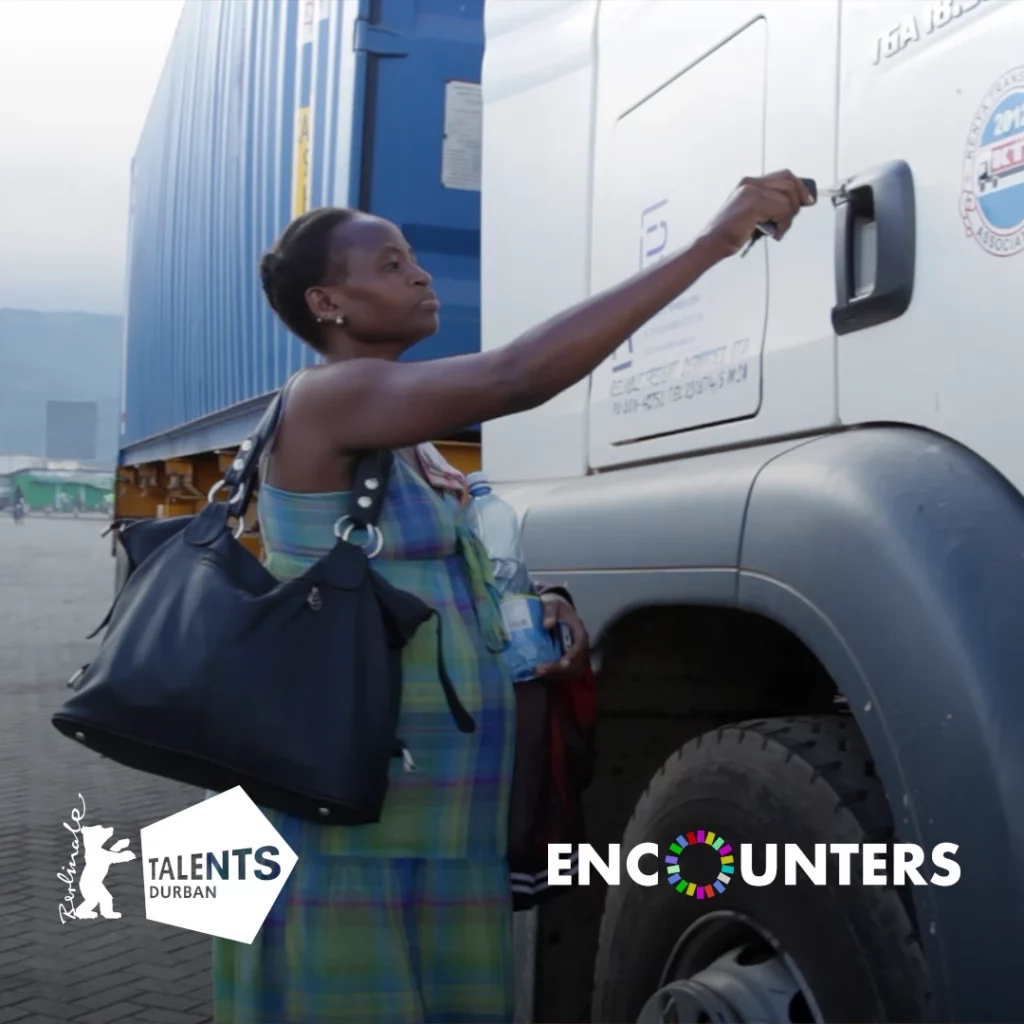
Meet Zippy Nyaruri, a filmmaker and upcoming producer, recognised for her documentary Truck Mama. Her film follows the story of Evaline, a female truck driver from Kenya, as she navigates her career ambitions and the emotional cost of raising her children from afar. In her film, she highlights gender roles and the modern African woman pursuing her ambitions while balancing motherhood. Truck Mama is a celebration of women in essential jobs and a lens into what values society holds dear. In this interview, we discuss Zippy’s filmmaking process and the themes of gender roles and feminist expressions in different professions.
A female trucker is quite the curiosity. Trucking is quite the macho profession, and the thought of safety and comfort on the road comes to mind. We’ve seen Evaline’s PoV, but for you, Zippy, following Evaline for years, what was your trucking experience?
Trucking is hard work. The experience exposed me to things that I had only experienced abstractly while working in film, which is also a male-dominated industry. With trucking, you are confronted with that reality every day. In film, there is a bit of a cushion, but none as a truck driver. At some point, the main cinematographer, a man, was not there, and it was just an all-female crew, and we really felt it. There was also the experience of moving from one county to another, one city to another and meeting different people, chilling with them and getting different perspectives. I got a lot of impressions, so it was not only one experience.
Is it safe to say that the gender experience is what stood out from your experience on the road?
Yes, that did show up, but only when a man was absent, can you imagine!
There were times when we were arrested, when the main cinematographer and the driver of our smaller car were there, but I felt it much more when we were by ourselves. For me, though, what stood out was the trip to South Sudan. It was hostile territory, and whether female or not, what we encountered was quite the experience.
I agree, I felt it too, watching the film. I am glad you made it out safe. Building on that, I would like your opinion on the role of employers. I feel that the situation would have been a lot different with a more transparent employer. Is this common in trucking, where employers focus on profit over safety, and could it be a consequence of consumerism?
That is clearly there, but it depends on the employer. They do put their profits first, and the more trips you make, the more money you make. Of course, some employers take good care of their employees and the trucks, but with this situation being a big company, they have a lot of truck drivers. They did try to solve it by giving her another truck, but it was still faulty. This happens to other drivers as well. Some drivers take on the responsibility of repairs themselves because of convenience. There is also distrust between employers and employees, where the former thinks the latter is lying or exaggerating when they could actually be in trouble. We visited another driver’s truck from the same company, and it was nice. It had a double decker, and compared to Zippy’s, hers was like a ghetto. We were bouncing around, and I understood why she was fighting for a better truck. With employers, there is always politics. That particular trip almost made her quit. It did not make the final cut, but one of the things she mentioned was that she would only go back if she got a better truck. At some point, she did get a better truck, but that was short-lived. A male colleague complained that she was getting a better truck. This shows how she’s also undercut as a female.
Gender really stands out as a theme in the film. There’s a particular scene where Evaline performs domesticity, which was a trigger for me as a woman, where we are often defaulting to patriarchal norms. For you, how did you keep your cool when seeing these gender expectations play out?
This is a very good question. We have feminism and gender equality, and in these instances, it showed me how different people fight this. Of course, there is the philosophical way of looking at it, where there is a way in which Western women and non-Western women approach it. First of all, for me, I thought that because she is doing a man’s job, I did not expect her to do these kinds of things. But she is also a feminist in her own way, and this is how she is expressing it. It is very layered, and that is why I like this scene. At one point, she is one of them making the jokes and talking about routes, and in another, she is like a younger sister. She wore so many hats. One of the things I always say, especially when we understand the microaggressions from the men, we get to see the nuance. For her, she laughs them off as a way of defence, survival. She’s finding a way in which she can cope. We might not agree with it, we might be upset, but this is her way to live with it. And that is the beauty of a documentary; it brings up this discussion. I left it raw as is and let it play out. I also have younger male cousins, and they expect you to do the domestic work, especially in the rural areas. For us, these are the things that irk us, and I can imagine the upset, and that is the point of making this film, so that it can bring about these kinds of discussions.
As a filmmaker, do you also face any workplace gender expectations?
There is always something you have to prove yourself in, where you have to do better or the same. You try to do a bit more, unlike the men. For Evaline, she just goes. For me, being in Europe is also another thing, trying to prove yourself in a new system, continent, and even language. In general, at least in documentary filmmaking, there is a lot more representation compared to fiction, but it’s there.
I appreciate that you took on the challenge. I think it is important to see more familiar faces in these professions.
I appreciate it because I always say my story is not about a public figure or an activist in any way. She is not a celebrity. I am happy when festivals and people like you see this. It’s an ordinary woman doing an extraordinary job, or essential work. I do appreciate the historical films that come out of Africa, but there is more to that; the next-door girl and this is what attracts me to these stories. Someone has to make them.
The film took quite a while to make. Did anything change throughout the process, and what were the challenges with such a long filming process?
It took a while because my own ‘truck” broke down, but I had to finish the process. I was still living on the continent during filming. I was between Kenya, Uganda and South Africa. I then became a mother myself, so I was also away from my child, and that was not easy. I had to wait for the right moment. I remember when we were filming, my daughter got sick and was hospitalised, and we had to put a pause on filming. I was always looking for moments to film. I then got funding and finished the process, and then moved to Europe. That’s when I fell through the cracks for funding. I did not belong on the continent, so I did not qualify for a lot of opportunities, and they also have different structures as well. That really was a cause of delay because I had to think out of the box about how to raise funds. No one really tells you how post-production is expensive, especially if you want to make it to the cinema; perhaps taking it to TV is different. Through it all, I was always thinking about this film, how to repair this truck so that it goes back on the road. I kept the momentum by continuing to develop by going to workshops and getting the rough cut. I was lucky that I had people who never forgot about it. This gave me the motivation, knowing some people want to see this film done.
I am glad you got it done. It is a very relevant story.
Thank you, I appreciate it.
We can finish on a lighter note. Will you be going on any road trips soon, and what would be on your playlist?
I do travel a lot because in Europe there is a lot of fluidity and it is a smaller continent. I really like road trips. My playlist is quite a mix, and it is my daughter who often selects it. But we do listen to a lot of audiobooks and audio stories.
Thank goodness the trucking experience did not ruin road trips for you.
Yes, though I wish travel within Africa could be a lot more borderless.
Thank you so much for your time, Zippy, and congratulations on Truck Mama.
Thank you.
This interview emanates from the Talent Press programme, an initiative of Talents Durban in collaboration with the Durban FilmMart Institute and FIPRESCI. The opinions expressed in this article are those of the author (Michelle Abuti) and cannot be considered as constituting an official position of the organisers.d in this article are those of the author (Michelle Abuti) and cannot be considered as constituting an official position of the organisers.