
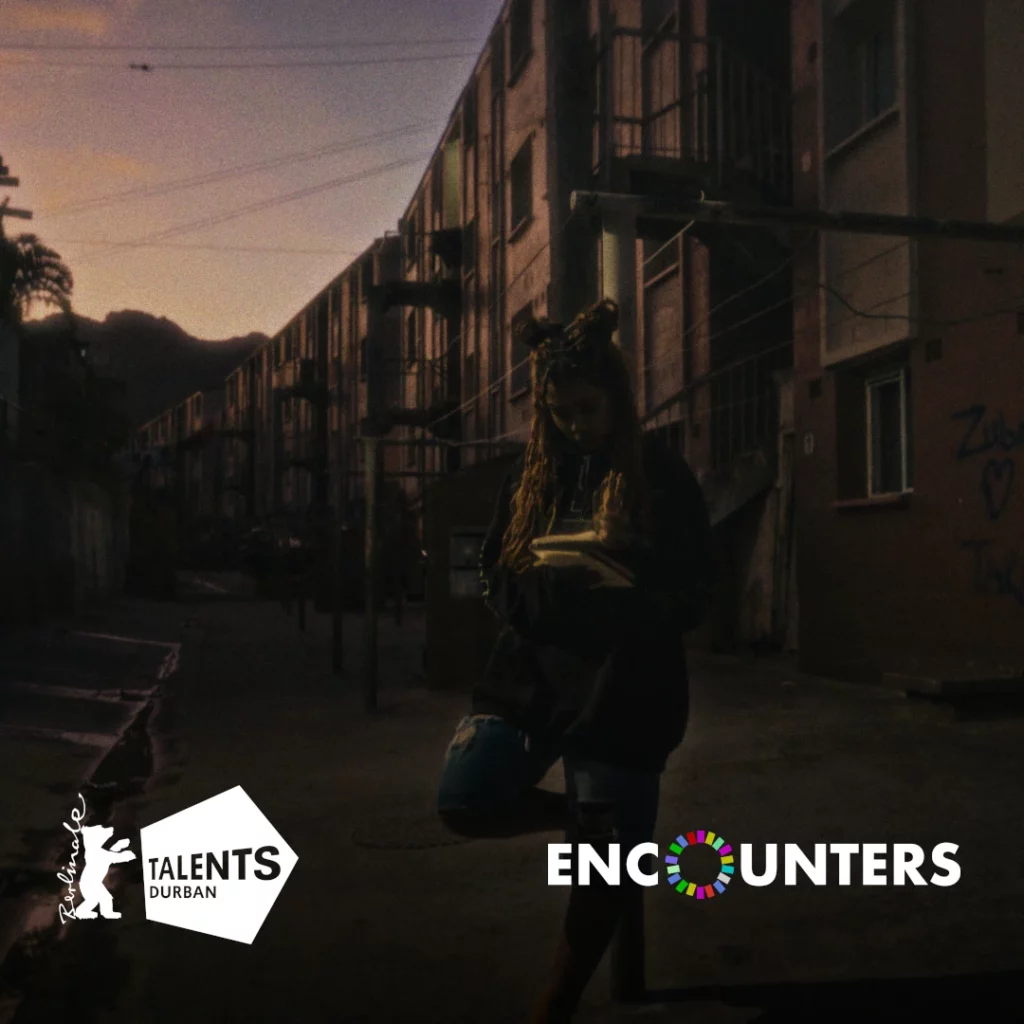
Notes from the Underground is an inter-generational dialogue, celebrating the sustained resilience and creativity of the Cape Flat residents, through its underground hip hop culture, where artistic expression becomes a tool for resistance, a subconscious search for the self.
Following its World Premiere at the Encounters South African International Documentary Film Festival, I spoke with the directors, Adrian Van Wyk and Chris Kets. In this conversation, they reflect on oral tradition as a dynamic process of inter-generational exchange, hip hop as a living archive of cultural and political expression, and the enduring structures of exclusion in post-apartheid South Africa.
Elijah Oluwanisola: One of the film’s most striking ideas is how it complicates, you know, this idea of elders as holders of history, and then the youth as receivers, you know. We see this kind of relationship where both old and young are re-encountering history. Was this a guiding idea in structuring the film, or was this something that emerged from the process of making the film.
Chris Kets: I would say the film itself is a deconstruction of history in a way, approaching it from almost like a nonlinear approach to history and history-making in a way. You know, the breaking up of the history and the conversation that happens in the edit when we have historical segments broken up and in conversation with the new and the old. And I think for us, it was layers of not only intergenerational exchange and conversation and sampling, in the hip hop sense of that word; of the old and the remixing into the new, but also even an ancestral conversation that’s happening across time and space. So, I think that was always a guiding thought in the film.
I think for us, it was always about mapping this exchange and this idea of an oral history and oral tradition, something that gets passed down in kind of encoded ways. A personal anecdote of me is growing up and learning how to do graffiti. There’s always this thing where, you start off as a graffiti artist, you start sort of copying people and then you’ll bump into someone who’s like… you know, you kind of get a bit dissed. Like you have to go back to the drawing board and then your stuff gets written over. It’s like a street culture thing where there’s this kind of earning of your place. But there’s also a passing over of the information and the history that happens.
I think it’s interesting how you observed it as well. The elders are also learning from an ancestral thing, but they’re also in conversation with the new school. I think it’s a breaking down of what we consider normal. The Western linear idea of time and history.
Adrian Van Wyk: I think it’s a cool observation that you made because a major sense is also how sometimes the wisdom of youth is not respected and acknowledged. In our attempts to create this intergenerational dialogue, the perception is always that it’s one way. It’s coming from the elders to the youth, but a cultural dynamo such as hip hop requires a two-way exchange. And so there’s definitely the old to the young, but there’s also the young to the old, where we’ve basically created these moments and these patterns and these rhythms of people being able to engage with each other, not only through the word, through the sound, but through the art, through the poetics, through the music, through the way in which they find new modes of expressing themselves within an existing frame such as hip hop. Hip hop is this endless frame that people exist within, it’s always evolving. And that evolution happens through a new generation that comes in and finds new ways of expressing themselves. So yeah, that’s a spot on analysis from your side.
CK: Through the film as well, we see kind of the political struggles of each generation. And in the old school, we’ve got, I guess, the fight against apartheid, and you’ve got the people in the streets and stuff. And then you see kind of the new school with characters like Dope Saint Jude thinking about things like intersectionality and the new struggles that they kind of continue.
When we look at Youth Day and the students who were killed in Soweto. It was the beginning, but that was the point that kind of then catapulted, I guess, into the state of emergency. But a lot of the time, it’s the youth who will take the struggle into the next phase.
I managed to watch MKO about the history of Nigerian elections and how, yeah, all these things are interconnected, but it’s like the new generation that also are the ones that can take it forward. I love the way that you brought in Afrophobia in your review, like into the present day, and how ideas of Pan-Africanism kind of were lost at some point, but that there is this way of connecting people and politics in a new generation and through a new struggle, but it’s also a repetition at the same time.
EO: Chris talked about the structure of the film, the fragmentation and the oral form. Why was that approach necessary? And how do you see it in relation to earlier traditions in African cinema that utilized similar strategies?
AVW: I think it’s important to understand the history of documentary within our context as African people. We have been the story and we’ve been in front of the camera for a long time. The agency of how we wanted our story to be articulated was most of the time taken away from us. And it was like the earlier documentaries where people started experimenting with the process of how the story is being told. So the fragmentation of the history within the timeline that we created was to also aid this idea of a circular narrative, where it’s not this linear idea from point A, B, C, because that’s not how we tell stories of African people.
We tell stories around the fire and people jump in and it’s similar to the logic of a hip hop cypher, which is circular, or the idea of a DJ bringing in the new cross fading. We wanted to have the methodology to reflect that, and the way in which cinema has also, the camera has been quite violent to us as African people. We wanted to also shift those dynamics and allow there to be a form of participation with the people who are telling the story.
The archive is fragmented, whether we want to acknowledge it or not. That fragmentation has been now passed down to a new generation, which is us. And we have to now figure out how we are gonna engage that archive? And I think playing with the archive was a major part of our process within the edit room. We really played with the archive. We had fun with it. We broke through different moments of history, kind of weighing us down. And then we decided to play with, I think that’s where the process opened up for us.
CK: I would say there’s a certain musicality to it as well. If you think of approaching history from a hip hop methodology, it’s like trying to make history through a jazz lens. I think that was a big approach. How do we use the archive as a sample and how do we break it up? The break beat as well. That moment when Kool Herc decided to loop the break, and that kind of creates this new form of music.
I think it was a lot of that kind of breaking things down, putting them in places that they shouldn’t have been and testing it out and seeing how it worked. So there’s this kind of digging and searching.
AVW: Also, the improvising, Chris. That was important in how we edited it as well, because the improvising is that lens that jazz and hip hop exists within.
CK: Yeah, the freestyle as well; the wild style.
EO: The film is co-directed and co-produced, with distinct responsibilities across research, shooting, and editing. How did that collaboration work across these stages in practice?
CK: Well, hip hop culture, at least, underground hip hop culture, is a very like communal form, and I think from the beginning, this film is part of a greater canon and a greater archival history that we are just adding to.
This was a collaboration, not just between Adrian and I, but, you know, all the people who’ve been making films on this subject and music videos and everything that came before. It was always this idea of co-creation and collaboration that was at the core of this project.
Adrian can go more into like the origins of the project and stuff, but at first, our approach was just kind of like trying to bring together all these voices from this huge movement in Cape Town. It’s big, but it’s also underground. Trying to capture the essence of this thing meant that we had to go very broad.
We went to all the people that we’d been making music videos with, people on the street. These are the people that form the creative scene. Cape Town is very big in a way, but it’s also small and it was a process of going broad and deep, and like trying to put everyone’s voices together to create one voice. Through time and through this process, we boiled it down into the essence, which is beyond the history, beyond the form, into the philosophy.
AVW: We also came with particular strengths and particular points of departure and it was in our collaboration and our co-direction, it was about leaning into those strengths as we came into this conversation. The research, for instance, was like my department to head up, while Chris was like on the cinema photography and on the edit. But we had a lot of conversations beforehand. We’d watch it back on set, have a conversation and then move forward.
The edit room was a very special place for both Chris and I, because it was a space where we had a lot of conversations about the themes, but we also had to hold each other, we come as two people with personal experiences into the space and we have to hold that. At the end of the day, whatever we did was to make the film represent the people that were in the film. It wasn’t about Chris or I. People have trusted us with their narratives and with their time. So, I think we had very clear moments of understanding the importance of dialogue between the two of us. That was very important.
We would spend sometimes two or three times a week in Bertha House editing-
CK: I mean, working between our other jobs and things that we had going.
AVW: It was the two of us at the center, trying to keep this thing alive, you know. Every Tuesday we would start with a conversation. We’d watch back, and we’d come in prepared of what we wanted to do next.
CK: What brought us together was our love and the impact that this culture had on us, you know, in different, but also similar ways. Growing up around this underground hip hop culture. It’s also just this creativity that is there in Cape Town that influenced my wanting to even become a documentary filmmaker.
We both felt like we were coming from these different spaces, but we had this connection, this similarity, which informed our politics and approach to creativity.
Also Adrian coming from his background in poetry and doing sort of underground poetry that provided platforms for people to do poetry in languages that weren’t normally seen as languages that poetry could be written in, he did some groundbreaking work. I was also doing a lot of music videos for underground artists. We both just knew and had already experienced the power of underground culture and what they can do to shape society and consciousness.
AVW: Yeah, we formed up and we got stronger together.
EO: The film deals with forced displacement under apartheid in Cape Town. How does that history relate to exclusion in South Africa today?
AVW: Colonial spatial planning and the logic of how the city of Cape Town works is still based on that design of who is in the center of the city and who has to be expelled to the margins of the city. It’s still very clear. We were very aware of that, but we weren’t intentional about naming it. We allowed the spaces to name that for themselves. We have conversations about it, but we don’t go into that avenue because we expect people.
We had a conversation with someone, Khalid, who was like, you don’t have to spell it out. We all know what it’s like. So, there was some responsibility required from the unfamiliar audience. When we started it, we were first doing a lot of explaining and then working with someone like Khalid, and Chris and I being in the zone, editing for like crazy amounts of time at Bertha House, shout out to them.
But, I think it was important for us not to not to name it, but to show it. And in that showing, that’s where your question comes from. For me, that’s a success, and getting a film critic in Nigeria, from West Africa, to understand that is kind of exciting for me; that we didn’t have to re-explain the trauma, but the trauma articulated itself through the landscape, and through the space and through the history and through the contemporary moment. Thank you for your question.
CK: There’s a political history, you know, that’s written in history books, and that’s controlled in some way. And that’s kind of used as a tool for certain agendas. Then there’s the people’s history that lives within everyone, within your grandparents, and that’s more like the kind of emotional history that you won’t get in the curriculum. That was the kind of history we were trying to tap into.
I think a lot of what happens in history, and I don’t know if it’s just about people in power, trying to hold on to power and whatever, around the world. But a lot of the time, it’s about trying to hide the issues and hide the things of the past, rather than trying to deal with it, or try to fix it. They always try to make people forget, or normalize things. I think a lot of things that happened during apartheid, have become normalized, and we don’t see it as a problem anymore, like something urgent that we need to fight.
Right now in Cape Town, we’re fighting this thing. They’re building a wall. They basically are trying to hide the township, the informal settlement, the fact that people are all living in shacks, as you come from the airport. That’s what they’re going to spend their money on, rather than going in and giving people decent toilets and infrastructure.
Definitely, a lot of these things from the past are carrying on today, and I the youth that are being born into it are born into thinking this is normal. But, you know, the struggle does continue. We don’t have the same people in power. It’s not like, necessarily the colonizer, but there’s still a very big fight for equality and, and the people’s living conditions. It’s always about democracy, are people really being heard?
EO: In the film, Marginalisation is present but it’s not the primary way the people of the Cape Flats are defined. We see more of their resilience, more of their creativity. How did you approach preventing it from becoming the dominant lens?
AVW: That’s a good question. Thank you for asking. It was important for us. We were also quite aware of representation within the context that we’re in, and many of the times the way in which cinema has impacted us in a very particular way, where we’ve been turned into caricatures of ourselves. We wanted to invert any form of negative representation and show the power and the innovation in which the participants are living. Despite the systemic injustices, people are still making dope shit. They are still using their imaginations to create art.
It wasn’t very difficult to sidestep the kind of centering of marginalization. Again, we allowed the image to speak to that, but we didn’t necessarily need to hammer in on it because the systemic conditions were prevalent within the images that we were building. The type of images we were making was to highlight the innovation of people who have been subjected to these forms of marginalization. So that was an exciting opportunity. It wasn’t a challenge at all.
It happened quite naturally as well. Because both Chris and I are both very intentional about how we portray people, using a lot of care in that portrayal. It was also part of the methodology that we created for Notes from the Underground; to center the intelligence and the innovation of the participants that we interviewed.
CK: I would also add that, “what you know about the Cape Flats isn’t all true.” That’s literally the first lyric that you hear in the film. And that was also our mission to show another side of the Cape Flats other than the poverty, crime, drugs, gangsterism, which is constantly repeated back to the people in the Cape Flats, and put out to the world and then manifested in a way, in the youth and in people’s minds.
I think hip hop is literally an organic street level response to this kind of thing, where without funding, these kinds of alternative school systems are created through the conscientizing that is hip hop, where people can analyze their own neighborhoods and their own spaces, through this lens. There are these kinds of organic intellectuals that exist in all these neighborhoods, that have for many years without any platforms been out there, philosophizing, writing poetry, creating art that’s on a crazy level.
We wanted to show that consciously, rather than focusing on gangs and the crime, which is there, you know, and it’s something we’re not shying away from. Two characters talked about being involved in gangs and stuff like that. But it’s survival, a response to poverty.
It is through hip hop that they find this new way of existing and a new way of thinking about their environment. It is also an act of trying to shift the kind of cultural hegemony that gets created. We know that there is all this stuff out there about the gangs and the violence on the Cape Flats and in Cape Town, but there are other things.
I think the more people that come after us and create things that are different, the more it becomes more acceptable in people’s minds that maybe the Cape Flats is also about art and poetry and like all these amazing things.
EO: Yes, I was going to mention that you as well, do not try to make them look like saints.
You’ve both talked about how the struggles of the older generation and the newer generation are quite different. Through the long years of hip hop in the Cape Flats as expression and resistance, how has its role evolved over time?
CK: Adrian wrote a thesis about this.
AVW: That was very long ago. Stop telling people that.
CK: Maybe the film was your second thesis.
AVW: Exactly! It’s important to clarify that culture is not stagnant. Culture is always changing, always evolving, morphing to the times. The people who are participating in it have struggles that also shift over time. It’s the same systemic struggle, but the systemic forms of exploitation and exclusion becomes a bit more sophisticated.
But our resistance has also become more sophisticated, because people are very aware, very smart and very clued up about these systems of exclusion. And so the way in which hip hop then gets used has the same root, but the way in which it is optimized in order to become a shield, in order to become a platform, in order to elevate your voice changes over time. So it’s important just to identify that in a space like Cape Town, culture and the cultural expression of hip-hop is still the same, but it’s also different, and it will continue to be the same, but it will also continue to change.
The framework is the same. It’s a platform of do-for-self, using samples to create. You’ve got to represent where you’re from, you’ve got to have respect. It’s all of those, but the modes of expression within the framework will always change. The technologies will also evolve. So it will become easier to make music of a higher quality, but it will also mean that there’s more responsibility in the maker to elevate their skill so that they’re not producing some whack stuff.
CK: It’s not just a commodity.
AVW: Yeah. I mean, that was important for us with the people that we interviewed. We interviewed a lot of people, and unfortunately, not everyone made it to the final cut. But there’s other possibilities with those stories, which both Chris and I have committed to doing. But I think it’s important to highlight that culture is not stagnant, it’s always adapting and it’s always shifting, but there’s always a new generation. There’s always a new audience that is engaging it to express themselves. And it’s always going to be at the center of some form of expression. That’s the kind of point of departure that we wanted to show.
There’s movements within the hip hop scene in Cape Town that we didn’t get the document, that came after the pandemic for instance. We were sitting with it, evaluating like yo! Should we film this? It’s a whole new form. That would be a whole new film.
CK: New filmmakers need to come and take and take it on.
AVW: We also had to focus. That was important man, because if we had to include try and include all the movements we would have still been in the edit room right now, because every three three to five years something new pops up, and we were working on this film since 2017.
We could have seen a bunch of movements come up, but we were very intentional, like when do we put a full stop? New sentences can occur but we didn’t want to start those new sentences, it was time for new voices to come through and start those new sentences.
CK: In terms of our film and stuff you’ve got like a crew like Prophets of Da City, which you would say is the first hip hop album in South Africa, some could be claimed Africa, but I don’t know that debate, I’d love to hear what else was being produced around the early 80s.
But it’s definitely one of the earliest official hip hop albums that came out. I’m sure people were doing hip hop in the streets you know and stuff, but like something that was recorded and pressed on vinyl. If you listen to the old POC stuff i mean, yo dude I would highly recommend, because it’s got such a crazy, very raw, very hardcore raw sound
That early hip hop sound was very much like fight the power and you know. It has that very revolutionary spirit you know, and there’s 90s and this other eras where people were getting a bit more introspective. You have people like Mr Devious has a presence within the film.
He was just like a lyricist beyond anyone, he inspired so many people he’s still inspiring the new school you know, like Lyrix. They still quote Mr Devious. He was a real street poet who used his lyrics and words, he went into prisons and did workshops with prisoners on how to use hip hop as a way of speaking about things happening in society. So, hip-hop in cape town always had a very like conscious undertone. Just like Emile YX? Says, it was what was around the political nature of our country.
And then we had pop moment when hip hop kind of became also pop music you know rather than underground music, and I would say that’s kind of what we’re still in, in a way. Hip hop has very much become a more radio friendly commercial kind of music, but I think there’ll always be underground no matter what, and we still have that in cape town, there’s still a very strong underground.
I think what’s happening now is there’s kind of a fusion happening where people like Lyrix who’s literally the daughter of Isaac Mutant and Kim Possible as you see in the film, whose name on her birth certificate is Lyrix you know, born into this time where hip hop is a commercial and popular form of music.
She’s still coming with that conscious lyrical heavy style um, and also now something like rapping in afrikaans or afrikaaps and mixing languages. That was like a very revolutionary thing in the 90s, people were still rapping with american accents you know, but POC (Prophets of Da City) were already rapping in afrikaans and afrikaaps.
Now, it’s kind of more of a normal thing that people are rapping in their mother tongues and mixing languages, and that’s actually getting radio airplay. So, I think there’s like a fusion happening, and whatever we consider the underground is also now in those popular culture spaces and I’m very excited about what someone like Lyrix is gonna drop soon.
EO: Looking at the film, is there anything that remains unresolved, even after bringing these voices and history together.
AVW: You trapped us man, you tricked us… No, I’m joking.
CK: What a question!
AVW:
The film was documented in a way that there were no resolutions, of course. It’s an open-ended conversation.
I am extremely happy with how we came to this point, but I feel there’s more, particularly two movements, two sequences that Chris and I have agreed on that we really miss in the film.
We won’t mention, but we’ll say that there’s potentially future opportunities to include those, and we’re always looking and revisiting how we could do that but for now I think yeah I’m really excited. Also, the response has been overwhelming for both of us. We did expect a response, but not this level. It’s really a great surprise.
CK: It’s always a thing when you’re making a documentary about a cultural movement, you can’t include everyone. There are questions around ideas of truth and reality surrounding documentaries.
Can you ever portray reality because we all are some figure of everyone we’ve bumped into in our life, and you’ve got to tell everyone’s story in order to get one story, you know, the real truth.
So it was always just going to be like a little portal, a little window into these vignettes of things that have so much context and histories and stories within each of these portals that could be unlocked and could be dug into more.It’s part of a canon.
This film itself is an act of archive making, and we hope that people after us are going to come and dig into this archive, look into some of these things, create more things and carry on the conversation. There’s a lot more stuff that could be looked into and unpacked with this film.
This review emanates from the Talent Press programme, an initiative of Talents Durban in collaboration with the Durban FilmMart Institute and FIPRESCI. The opinions expressed in this article are those of the author (Elijah Oluwanisola) and cannot be considered as constituting an official position of the organisers.d in this article are those of the author (Elijah Oluwanisola) and cannot be considered as constituting an official position of the organisers.