
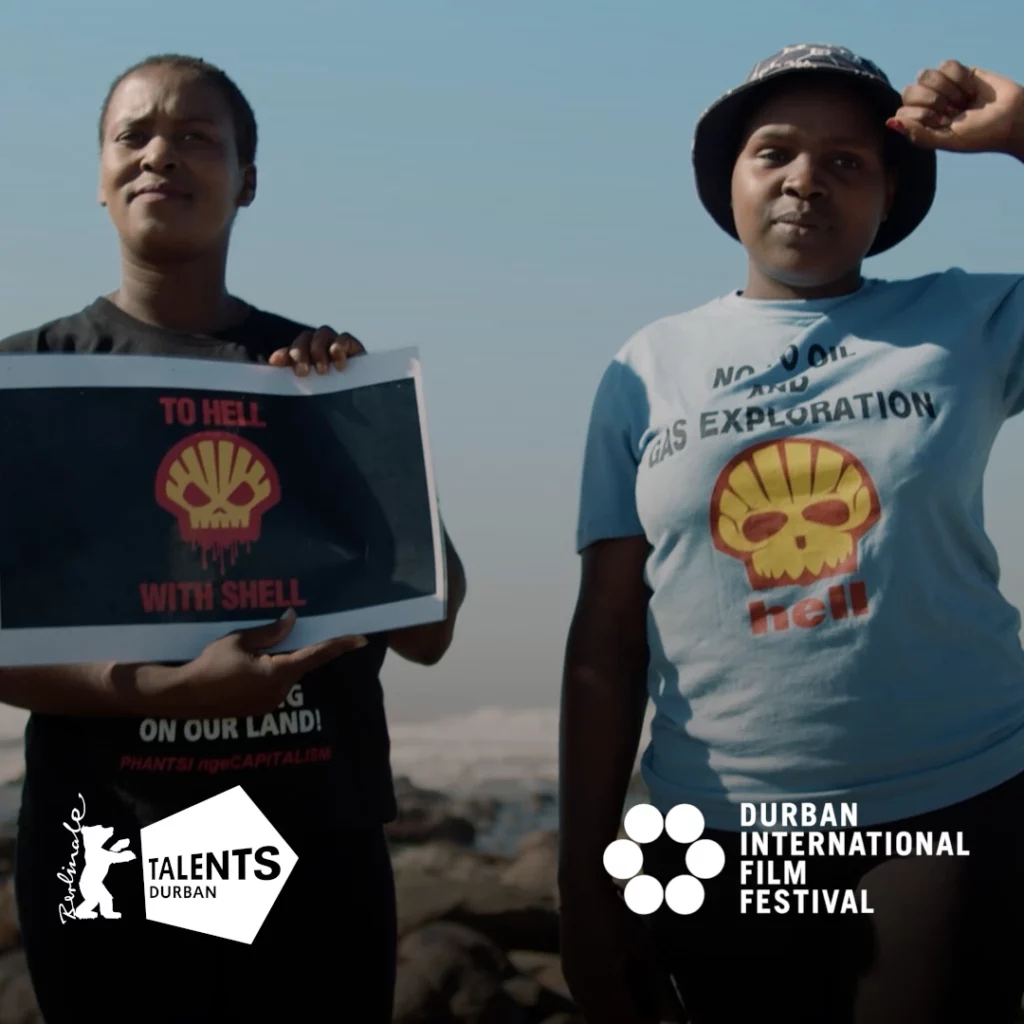
Boima Tucker’s After Oil examines the effects of green energy transition on the Global South. By engaging with communities across Africa, the documentary centres the perspectives of those on the receiving end of international energy policy in Africa, interrogating who bears the cost and who benefits from the transition.
The documentary opens in Cape Town with a speech by South Africa’s minister of Mineral Resources and Energy, Gwede Mantashe, delivered at the 2022 African Energy Week. He argues that the Africa “we want” depends upon a stable economy built on inclusive growth, sustainable development and universal access to energy. Drawing on his childhood village in Eastern Cape he notes that although nearly every household is connected to the electricity grid, many still rely on firewood for cooking. He exemplifies this as a form of electricity poverty, noting that access is not just by connection to the grid, but by the ability to maximize it.
We then cut to Sigidi in Pondoland, where farmer and activist Nonhle Mbuthuma recounts a childhood marked by swimming in Estuaries, gathering seafood, collecting firewood, and walking 12km to and from school each day. “Life was gold,” she says. Mantashe speaks of infrastructure and policy; Mbuthuma speaks of place and memory. Here, we see two diverging conceptions of development in discourse. We see the limitations to a vision of the state as opposed to the everyday realities through which communities experience development.
Mbuthuma’s work with the Amadiba Crisis Committee (ACC) against Shell’s proposed mining reveals the documentary’s concern beyond environmental degradation. Even before extraction begins to affect geography, it alters the social life of the community. Mbuthuma recounts how mining companies have sought to divide the community by bribing those uncertain about the project, and how the struggle itself has resulted in deaths of community members whom the activists suspect were poisoned.
The consequences are revealed in the community’s social life. In a community where food was previously freely shared, suspicion has resulted in meals no longer being trusted. Here, we see extractivism as not merely exploitation of land but as a threat to communal bonds upon which that land derived its meaning. Through her insistence that displacing people from their land creates a “dependent syndrome,” Mbuthuma expresses a broader political stance of land not being only a productive resource, it is as well a material condition of autonomy; a disturbance in the relationship of people to their land results in dependency on the same institutions and corporations responsible for the dispossession.
While the documentary dialogues with the effects of oil extraction on small communities and the environment in South Africa, it takes a different approach in Kenya. Though most of Kenya’s electricity is generated from renewable sources, its distribution still emphasizes inequality. The power distribution company has a reputation of estimating electricity consumption rather than reading meters to calculate bills, resulting in outrageous bills. Residents of informal settlements like Mathare, many of whom lack electricity meters are frequently excluded from the grid, and this, besides the cost, leads to illegal connections in these areas. Here, the documentary exemplifies that energy transition is not synonymous to just transition.
In contrast to this systemic neglect, the community takes responsibility for itself, through the Mathare Social Justice Centre, which undertakes tree-planting initiatives and environmental education programmes initiatives. Similarly, the work of, Taleb Brahim in the Sahrawi refugee camps in Tindouf, Algeria is highlighted. By adapting hydroponic technology into low-cost systems built from locally available materials, he tackles dependency on food aid, enabling refugee communities to cultivate food in one of the world’s most inhospitable environments.
In one of the documentary’s closing reflections, Algerian researcher-activist, Hamza Hamouchene, argues that a just transition “is deeply anti-capitalist. It is an anti-imperialist project that places working people in the largest sense. From the industrial working classes, to small scale farmers, to the fishers, to agro pastoralists, that is marginal by the capitalist system. That just transition needs to benefit those people not happen at their expense.”
After Oil embodies the inclusivity it advocates by engaging voices from across the continent: political leaders and diplomats, activists and community members. It interrogates extraction, occupation, imperialism, climate politics, recognizing that climate justice cannot be separated from other systems of oppression, but it doesn’t always fully articulate the conceptual connections between them, leaving the viewer to infer these connections that the documentary itself leaves implicit. This results in a documentary—or, more accurately, a piece of reportage—rich in perspectives but less successful in synthesizing them into a coherent argument.
This review emanates from the Talent Press programme, an initiative of Talents Durban in collaboration with the Durban FilmMart Institute and FIPRESCI. The opinions expressed in this article are those of the author (Elijah Oluwanisola) and cannot be considered as constituting an official position of the organisers.