
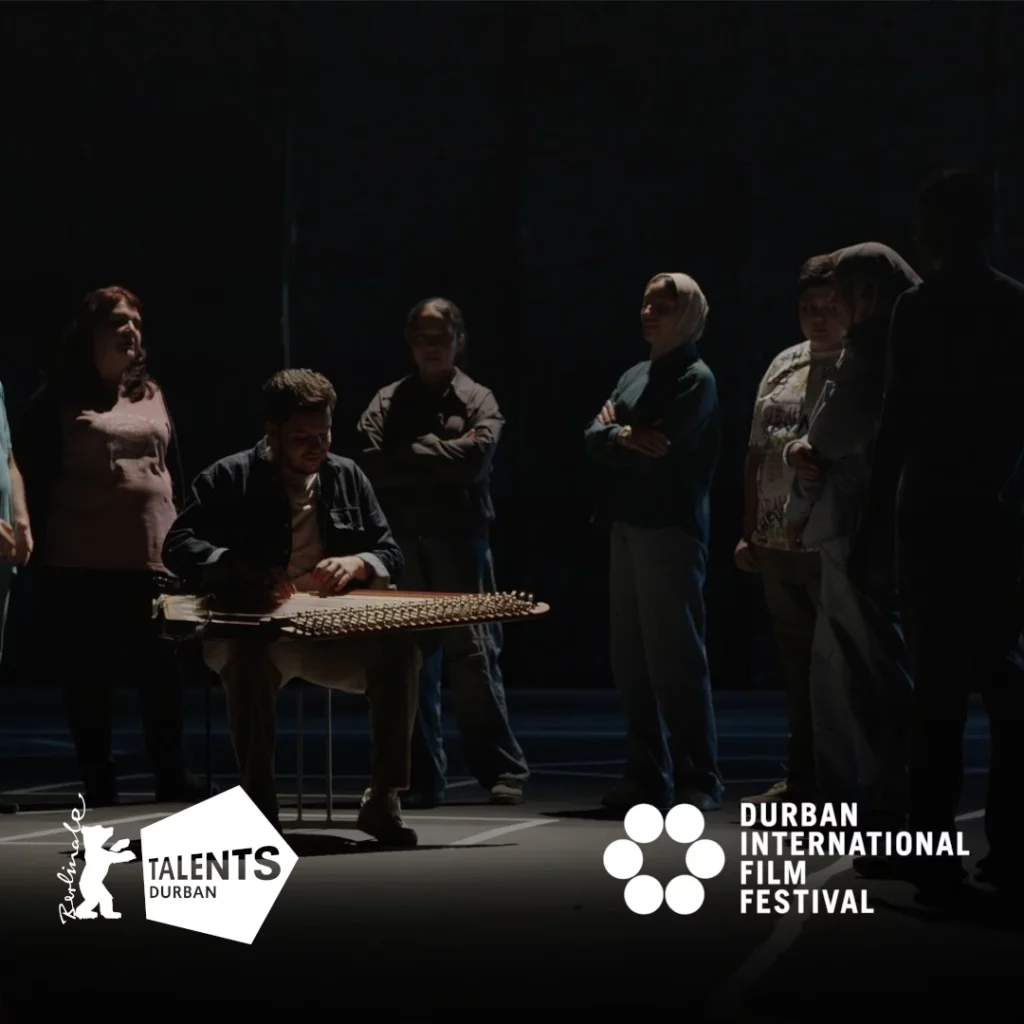
Our homes are not physical spaces that house us. They are not buildings or simply a roof over your head. They hold a special meaning in our lives and have great sentimental value. Homes are like loved ones. The subjects in Who is Still Alive share this reality after fleeing their homes. Their loss is indescribable. With little mementoes that they managed to hold on to, we hear the account of Palestinians lucky to flee their homes.
In October 2023, Israel launched a devastating offensive against Palestine. This period would be when the world turned upside down for most Palestinians. Fleeing to different countries, the focus of these nine survivors has found itself in the state of South Africa. In a bare sound stage, a map of Gaza is drawn, each with representations of their homes. These are their accounts;
Jawdat Koudry, a towering man, a father, and to whom the group affectionately refers to as Abu Naji. He is a pillar of his community. He owned a sponge and mattress factory as well as curated a museum that housed Palestinian heritage. Ancient robes and jewellery as an archive of his home country. Jawdat was reluctant to leave despite seeing his business fall – he could rebuild that; he’s done it before. The museum, bulldozed and flattened with its treasures inside. He still would choose to stay, one thousand times and over.
Eman Shannan was used to death. This, however, had nothing to do with her position as a medical doctor but with being accustomed to war. Her life was death. She expected the genocide and prepared for the worst. When it was clear that she had to flee, her patient’s records were the primary concern.
Haneen Harara was just waiting her turn. Being in Gaza means that you’re dead anyway. International conventions dictate that journalists are spared from being held hostage or killed in war. This rule, however, did not apply to Haneen, who left her home behind. Their family home, which was their pride, was taken over by Israeli soldiers and used as a base. When they were done, they set it alight. When her little niece was killed in an attack, Haneen’s soul died along with her. She would never have her niece bouncing on her knee again.
Malak Khadra is a filmmaker with a strong social media presence. She showcased the beauty of Palestine through her online platform. Malak and her sister had built a studio along the shores of the river/sea. She was proud of it and her work. Now it is all reduced to rubble.
Feras Elshafi, bright and chirpy. Lost most of his friends, people he grew up with. The day his home was destroyed, he left only with his qanun. To remember his homeland, Feras plays a Palestinian melody wistfully.
Hana Eleiwa never imagined that she’d leave. In her own words, she anticipated that it would only be a few days and the shelling would stop. 25,000 USD later, she was far away from home, and her mother was left behind. A phone call or a text from Gaza triggers anxiety: has she lost another loved one?
Gada Alabadla had to choose between her studies and bare necessities. She had plenty in her home. Sprawling gardens filled with olive trees and fish ponds. In her new school, she cannot sing their national anthem; she doesn’t know it. She only knows the Palestinian anthem. A constant reminder of the home she lost.
Adel Altaweel had made it safely to Egypt, only to turn back in the direction of danger to reunite with his family. This was a bittersweet reunion; his father had hoped that with him away, their family might survive through him. Indeed, his family name survives at an unimaginable cost.
And
Mahmoud Jouda, also Abu Baghdad. Crying is pointless, and this is not about stoicism. For him it is pointless. He claims his right to exist through writing. The Palestinian experience for him is marred by violence, a reality he hoped his daughter would escape from. He wrote about the beauty and wonders of Palestine. Parks and historical places that Baghdad could trace when they would eventually return. At this moment, they only exist in memory, flattened by Israel’s military campaign.
When war and genocide happen, it is not only the people that die. Who Is Still Alive evidences that. Bare in his filmmaking, Nicolas Wadimoff efficiently captures the loss. These refugees had everything but lost it all. It is not just the material loss of their livelihood and pride but also their families, culture and soul. Some things can never be rebuilt or reclaimed. Such is the extent of the devastation of Gaza. To describe it as a genocide is not enough; this is an active campaign to wipe out an entire people’s existence from history.
Stories of war reach us from journalists’ accounts; Who Is Still Alive reaches us through their past lives and their last days in Gaza. In essence, when they have been removed from their homes and seen their culture wiped out, are they truly living? When their entire existence is punctuated by wanton violence and living expecting death, what kind of existence is that? Watching this film was very difficult. I could not imagine losing my home. From their accounts, I was paralysed by the details of their escape. Choosing what to bring with you. Essentials or the precious objects that would connect you to your homeland. Wonderful objects that bring meaning into our lives. This detail is emphasised with the refugees accompanied by a little piece of Gaza they managed to bring with them during their escape. For Dr Eman, a laptop that connected them to her qualifications and the pride for her professional achievements; for Feras, his Qanun, so that he would play Gaza’s melodies; and for Mahmoud, his books, an archive of the golden days of Gaza. I wonder what I would bring and what it would take to choose what stays and what I leave behind. Never have I had a first-hand account of genocide in this manner. The accounts made me confront my privilege. I have never been accustomed to death and violence; I do not even know the words for missiles or shrapnel in my language. This is because I have not needed to describe these situations. If one is still on the fence about Israel’s campaign, surely this film will move you.
This review emanates from the Talent Press programme, an initiative of Talents Durban in collaboration with the Durban FilmMart Institute and FIPRESCI. The opinions expressed in this article are those of the author (Michelle Abuti) and cannot be considered as constituting an official position of the organisers.