
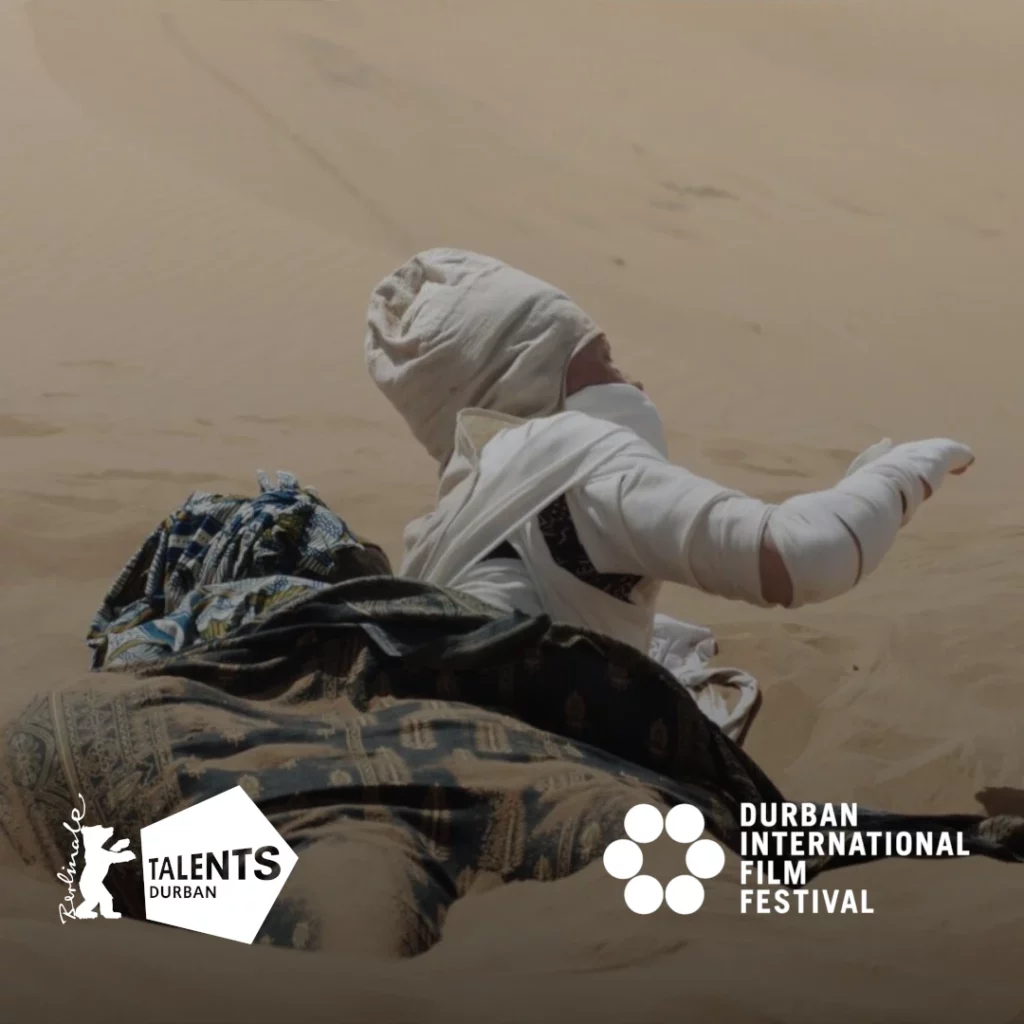
The representation of people with albinism, like most marginalized groups, on screen—especially by outsiders to the community—is, quite often, met with suspicion, as such undertaking frequently extends into exoticization. The beliefs and stereotypes associated with albinism are often reproduced on screen; characters with albinism are frequently portrayed as mythical creatures, vulnerable victims, or as comic devices—the other.
A recent example of an ideal portrayal of the subject is Kenny Mumba’s Can You See Us?, a film loosely based on the life of the Zambian musician, John Chiti. Here, stereotypes associated with albinism are both portrayed and challenged. Portrayal, however, is what is at the heart of Azlarabe Alaoui’s Africa Blanca, subtitled The Color of Exile, screening at the Durban International Film Festival simply as The Color of Exile.
The Color of Exile centers on Oussmane (Abdoul Aziz Dabakh Sahl), a young Senegalese albino, and his mother Aichata (Naky Sy Savane), who, already living in isolation, eventually flee their homeland—embarking on a precarious journey to Europe—to escape death threats from community sorcerers. The film opens with a text citing a United Nations report on the commodification of albino bodies fueled by fetishism. It ends with a moral aphorism, “The only thing necessary for the triumph of evil is for good men to do nothing.” This is then followed by a scene where Oussmane spies on a bonfire ceremony, on being noticed, he flees home. This simple indication of autonomy is perhaps the only time Ousame takes action unmediated. For the rest of its almost 2-hour runtime, Oussmane becomes a frail youth, unable to survive without the sheer handholding of his mother.
In the first instance, Aichata bathes Oussmane, who appears to be in his late teens. This act, perhaps intended to be an extension of a mother’s unflinching love, instead reinforces a major stereotype about people with albinism—they are not self-sufficient. Some years back when I would take walks with my albino friend, our discussions were often interrupted by echoes of strangers asking me to hold his hands so he doesn’t get hit by a car. The problem is not that this portrayal is not that it exists in the film, it is that it is not contended.
Similarly, on two occasions in a Zaouia—where Oussmane’s father was a scholar— in Morocco, and in a transit camp for travellers seeking to passage to Europe, the presence of different areas for male and female is met with pushback from both Ousmane and his mother, he even asks that they leave the Zaouia for this reason.
At the start of their journey, one traveller, motivated by superstitions on albinism insists that the leader evict Ousmane from the group so he doesn’t bring them bad luck. The leader refuses, motivated less by compassion than by money. As the journey progresses, Oussmane and his mother struggle to keep up with the group, consistently lagging behind. Later on, some group members conspire against them: pinning his mother down and throwing him off a moving truck. When the team leader hears the scuffle, the vehicle is stopped for Aichata to go after her son. The group eventually drives off, leaving both mother and son stranded.
An important figure in the mother and son’s journey is Zoubir (Zahra El Houaoui), an impish young woman whom they meet in the desert. She becomes integral to their navigation in Morocco—after leaving the Zaouia—and in furtherance of their journey to Europe.Oussmane begins to develop a bond with Zoubir and her impishness begins to rub off on him—at one point he wanders off from his mother, and smokes hashish with Zoubir. Yet these moments of personhood never amount to a meaningful challenge to the stereotypes the film already reinforced.
In tandem with Oussmane’s story lies the harsh reality of the trans-Saharan and the Mediterranean migration routes to Europe. Aichata’s nephew Amadou (Douabe Zappa Jackie)—now, Le President—whom his father believes to be in France for seven years is found to be the leader of a migrant group. His dream is to eventually get to France and become president—Barack Obama did it, so why can’t he? Zoubir finds Amadou’s aspirations comical, and perhaps some viewers will share that sentiment. This impulse to spectacularize precarity extends beyond the narrative into the film’s formal choices.
The early desert sequences at the start of the mother and son’s trip possess the exhibitionist temperament of a tourism commercial. A perilous journey influenced by socioeconomic factors is largely seen through majestic aerial shots showcasing the landscapes grandeur, laced with desert-coded sonic palette.
The performances are as uneven as the film itself. Much of the cast comes across as bizarrely stiff and mechanical. Even the iconic Naky Sy Savane, so commanding in classics Ousmane Sembene’s Moolade, Roger Gnoan M’bala’s Au nom du Christ, and Fanta Régina Nacro’s La nuit de la vérité, leaves little impression here.
For all its faults, The Color of Exile still offers flashes of brilliance. In one scene, right after Ousmane asks why she dresses like a man, we see Zoubir, now by herself, in front of a mirror. She is dressed in women’s clothing with lipstick on. She slowly begins to scrub her face, wiping off the lipstick. She reaches for the mirror, scrubbing it as well. Here, we get hints of an identity crisis behind Zoubir’s mischief. Similarly, we learn that Ousmane is a poet, but this creative aspect to him is hardly substantiated left for one elegiac poem he writes that is transposed across that does some bizarre heavylifting to cover up for the film’s inability to explore Oussmane’s personhood.
The sustenance of inept cultural interpretations, superstitions and misunderstandings constitutes a motivation for the perpetuation of prejudice and discrimination against persons with albinism. Not only should these narratives be addressed, they should also be challenged. Yet The Color of Exile rarely rises to challenge. Instead of interrogating the structures that sustain these beliefs, it limits itself to a reflective representation of these structures, while punishing nearly every act of solidarity. Aichata dies, Zoubir forfeits her long-awaited journey to cross to Europe, Amadou—who has been attempting to cross the border for five years—is confirmed dead in a television news report after helping Ousmane and his mother. Ultimately, the film becomes the very good man alluded to in its opening—the one whose inaction allows evil to prevail.
This review emanates from the Talent Press programme, an initiative of Talents Durban in collaboration with the Durban FilmMart Institute and FIPRESCI. The opinions expressed in this article are those of the author (Elijah Oluwanisola) and cannot be considered as constituting an official position of the organisers.