
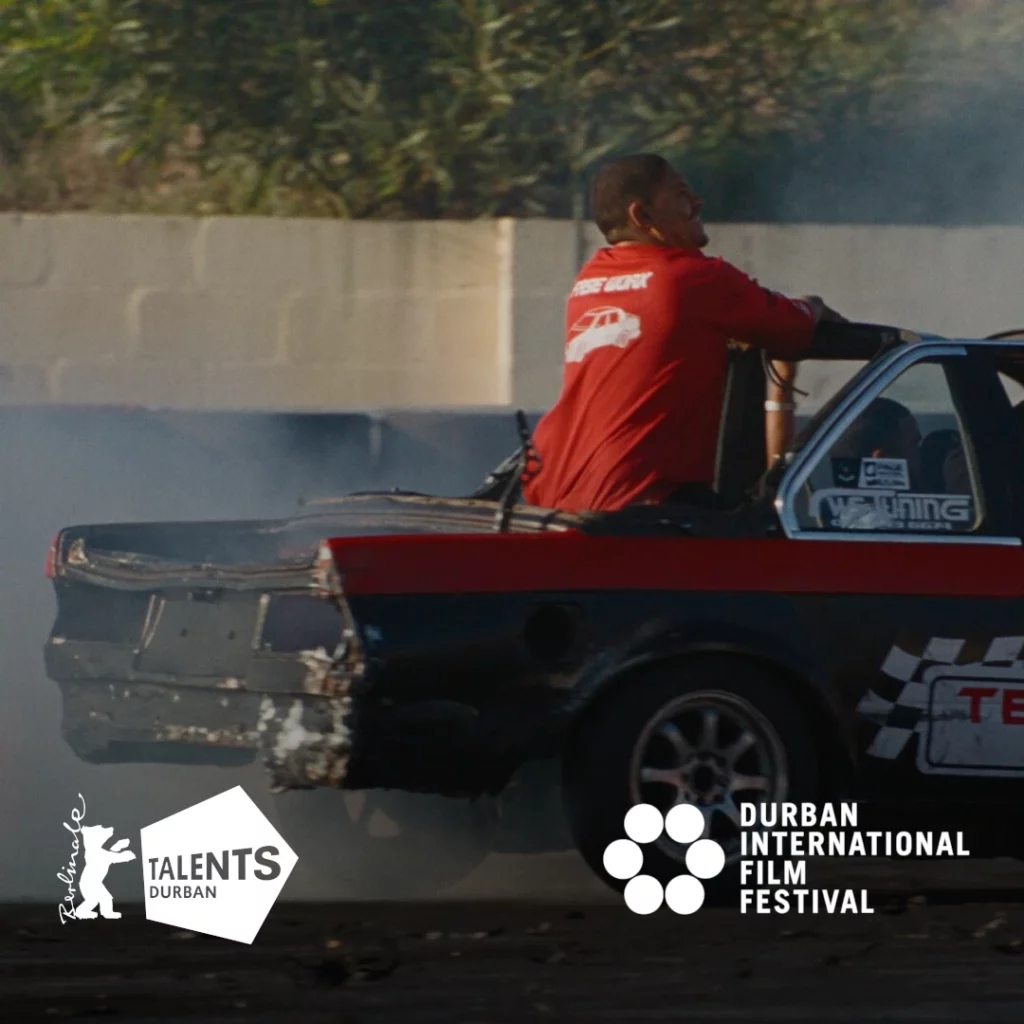
Now that the FIFA Frenzy has died down, I shall point you in the direction of a fringe phenomenon, more adrenaline-inducing, rivalling a butt-clenching penalty shootout. It involves speed and power. If your first thought was a motorsport, then you are absolutely right. From Dust we Spin introduces us to the dizzying sport of car spinning.
“In the ashes of the Cape Flats,
Where the wind carries the Whisper of gunfire and gospel,
A beast was born… This is pure rubber ripping the tar.”
This poem opens the film, providing a backdrop for Logan’s story. A young woman raised in the Cape Flats and her journey to the world of car spinning. This is not a straightforward journey, with much of the friction coming from her home. Her mother is strongly against the sport not only because it is dangerous but also because it is still considered illegal. Logan’s stubborn defiance of her mother’s will stems from her struggles with her mental health. Likewise, this very fact reinforces her mother’s fears about Logan’s involvement in the sport. Logan’s teacher, Mark “Bull” Lindon, also has a strong connection to the sport. Poverty in the Cape Flats oftentimes leads to a direct pipeline to gang activity for young men, and it is through spinning that he was able to stay out of jail. They are also connected through their relationships with their mothers. For Mark, the sport is a way to keep her memory alive. Car spinning, therefore, presents a lifeline for these two. As Logan’s spinning skills improve, she slowly comes out of her shell. In the end, we get to witness the ultimate cathartic release – Logan mastering her craft, with the full support of her family and community.
This is definitely not a film about cars. The spinning, however, enthrals us from the opening shot and makes a clean exit on the closing shot. This captures the subjects’ ride out of their struggles. Julia Jansch has effectively captured the curiosity of her audience, prompting them to confront difficult themes in the documented community. Teenagers and youth are represented by Logan, who struggles with her mental health. For Logan’s teacher, Mark, who represents the adults in the community, it keeps him grounded and gives him a legacy to pass on; for the larger community in Mitchell’s Plain, it offers common ground for them to enjoy fraternisation and bond over shared experiences. Admittedly, spinning is an unusual sport to bond over, especially in the context of disadvantaged communities such as those of the Cape Flats. Looking at historical context, we learn that it was a way for members to congregate during apartheid and has evolved as counterculture into a sport that is slowly being standardised and recognised by state bodies.
What is most fascinating about the connection to spinning to Logan and Mark is the massive pull it has on their survival. Watching the film, we are treated to slow-motion shots and sequences that glorify the sport. Bits of rubber ripping off tyres, smoke and dust cloud the screen, turning its drivers into a spectacle fit for a high-octane action flick. If you remove the special effects, the cool factor, and enhance the theatrics with stunts, a different kind of adrenaline kicks in – the potential danger of this sport. It therefore makes for a very compelling story of how the sport bears such significance to their lives. Described as a drug, car spinning ends up being an effective antidote with enough force to pull Logan out of the depths of depression. Even with strong initial opposition from her mother ends up being her number one supporter. In the Cape Flats, where gang activity still plagues the community, car spinning is presented as an alternative that youth can engage in to keep themselves out of crime. Mark serves as an example for this. The sport offers him a channel to let go of his past and embrace a legacy that uplifts a community. It is therefore very frustrating to see authorities dragging their feet to implement the legalisation of this sport. To be precise, a dedicated track for the drivers of Mitchell’s Plain.
From Dust We Spin had me rushing to get a deep dive into the spinning culture. Something that I thought only existed in music videos, I gained a deep appreciation for the forms of resistance that exist today. In South Africa, spinning evolved from apartheid resistance into a recognised sport. In the context of this film, From Dust We Spin tells us something greater: confronting death allows us to enjoy life. Spinning gave Logan a lust for life, and Mark found new direction for it. Their past was left in the dust, and spun anew to embrace life. For the sport itself, if you want to experience the theatrics of Mia’s “Bad Girls”, head down to the Cape Flats and get a load of tar!
This review emanates from the Talent Press programme, an initiative of Talents Durban in collaboration with the Durban FilmMart Institute and FIPRESCI. The opinions expressed in this article are those of the author (Michelle Abuti) and cannot be considered as constituting an official position of the organisers.